Anhydrite screed – what is it, what are its advantages and disadvantages, and how does it work with underfloor heating?
Are you building a house or getting ready for a major renovation? You’re probably now faced with the choice of what will go under your floor. Anhydrite screed (anhydrite floor screed) is a topic that has revolutionized the way we think about screeds in recent years, especially if you’re planning underfloor heating. This is a solution where anhydrite screed works perfectly in modern construction.
Anhydrite screed is one of the most frequently chosen materials by informed builders. Every investor who values time and quality should consider this type of screed. In this article, we’ll go through everything you need to know about this material. We’ll check what the price is, what the characteristics of anhydrite screed are, discuss the thickness of the screed, and answer the age-old question: anhydrite screed or cement screed?
What is anhydrite screed – definition and basic information
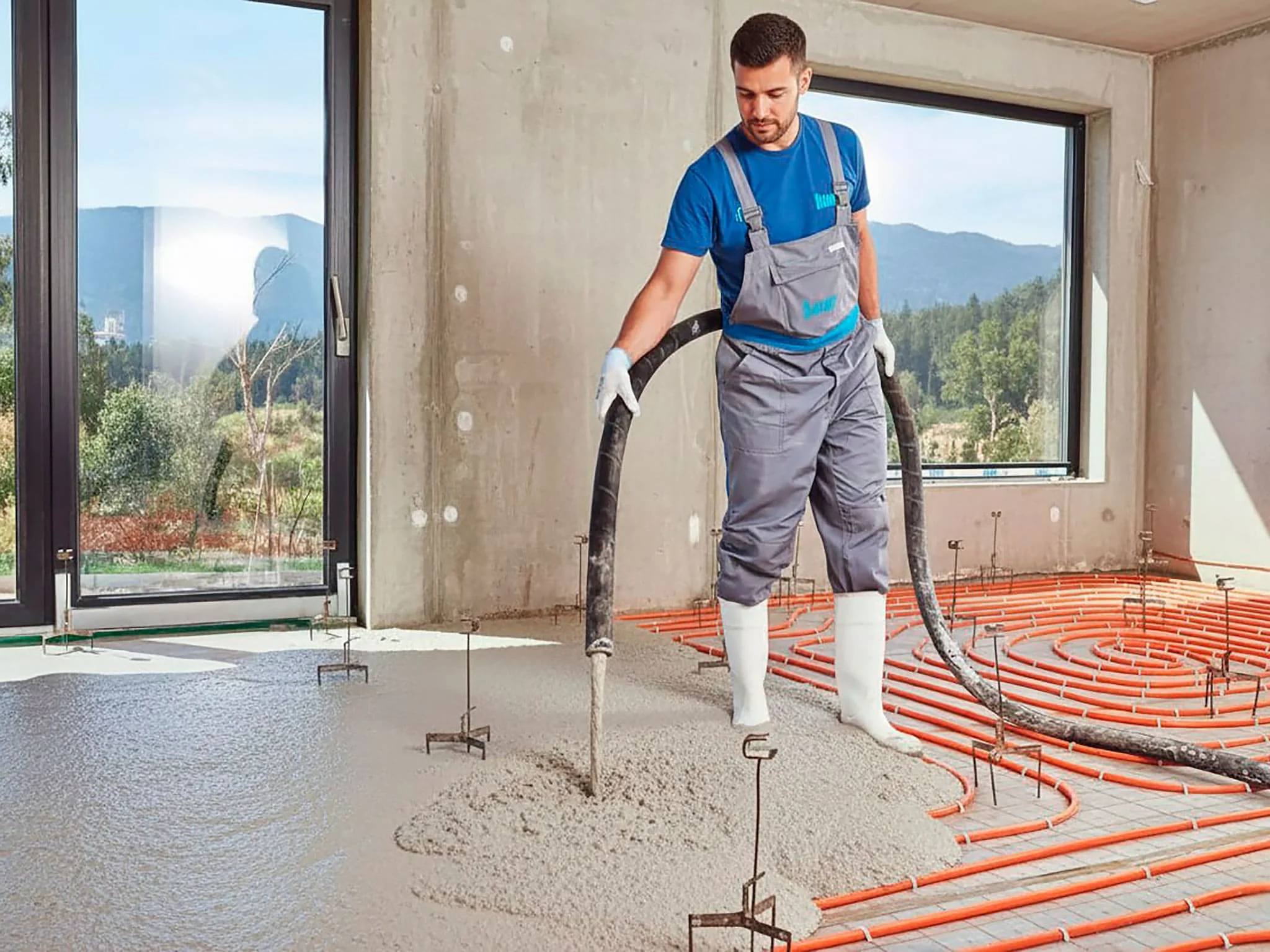
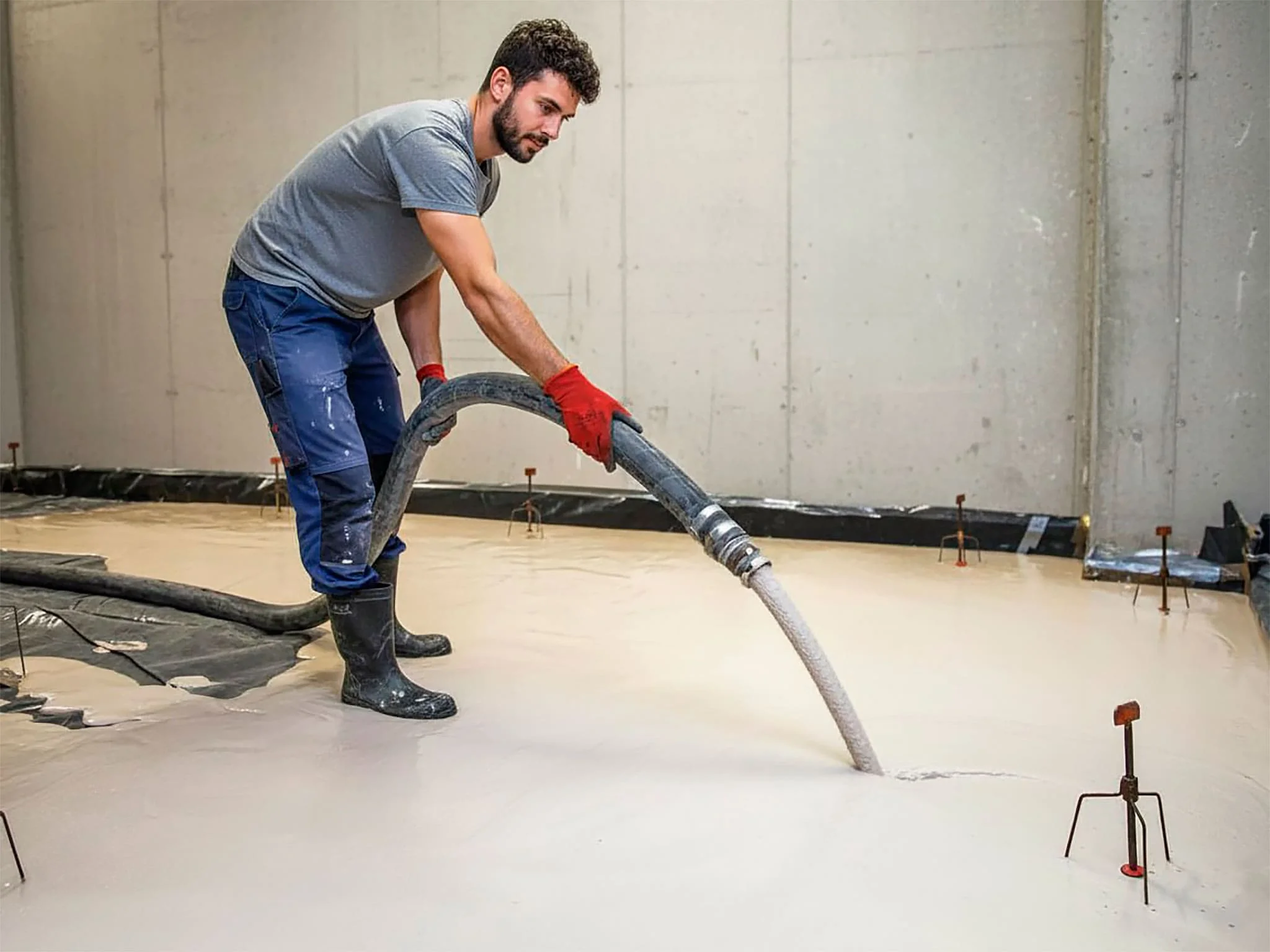
Anhydrite screed – what exactly is it? Simply put, anhydrite screed is a type of floor underlayment made from a liquid, sulfate-based mixture. Anhydrite screed represents a modern alternative to traditional solutions. Its distinctive feature is its self-leveling properties. What does this mean for you? That after pouring, the mixture spreads itself out perfectly evenly under the influence of gravity. This creates a smooth surface that doesn’t need to be painstakingly patched. Anhydrite screed therefore provides the perfect base for finishing works.
What is this made of?
The main ingredient, the heart of the entire system, is anhydrite (anhydrous calcium sulfate), which serves as the anhydrite binder. It acts as the binding agent here. Suitable aggregate, water, and special additives are then added to make the mixture so fluid. Anhydrite screed does not require reinforcement, which is a significant difference compared to traditional cement screed.
What is the difference between anhydrite and cement screed?
The differences are obvious, especially in consistency and workability. Anhydrite vs. cement screed – here are the main differences:
- Anhydrite screed (also known as anhydrite floor) is fluid, non-shrinking and lighter (the weight of the screed is lower);
- Cement screed resembles wet sand, it needs to be troweled and reinforced.
What properties and advantages of anhydrite screed are worth knowing?
Why has this floor underlayment become so popular? The advantages of anhydrite screed result from its physical parameters.
Thermal conductivity – why is it so important for underfloor heating?
This is probably its biggest advantage. Anhydrite screed has a high thermal conductivity coefficient (often informally referred to as a high heat transfer coefficient), which is around 1.6–2.0 W/mK. Thanks to this, anhydrite screed heats up several times faster than cement screed. Its liquid consistency perfectly envelops the pipes of underfloor heating systems, leaving no air pockets.
Self-leveling and perfect level
A floor made of anhydrite is as flat as a table. When you lay floor panels or large tiles, you won’t need tons of adhesive to level the surface. This is precisely because it has self-leveling properties, so installing anhydrite screed requires very little effort during the finishing stage.
Thickness of anhydrite screed and parameters
The thickness of anhydrite screed can be thinner than cement screed. Typically, a minimum of 35 mm is used above the heating pipes. A thinner thickness means less load on the ceiling.
Where can anhydrite screed be used? – Applications
In which rooms is it worth using it?
The applications of anhydrite screed are wide-ranging. Liquid screed is ideal for single-family homes as well as large offices. Due to its low shrinkage, expansion joints are needed less frequently—you can pour areas of up to 300 m² (with heating) without cuts, unless you’re dealing with narrow passages or sections with a complicated shape (for example, even for areas up to 25 m² with an irregular layout, it’s worth consulting the expansion joints with your contractor).
Where should you be more careful?
Despite its many advantages, you need to be careful in damp rooms (bathroom, garage). In places where there is a lot of water and slopes, cement screed is often a better choice.
What does an anhydrite screed look like?
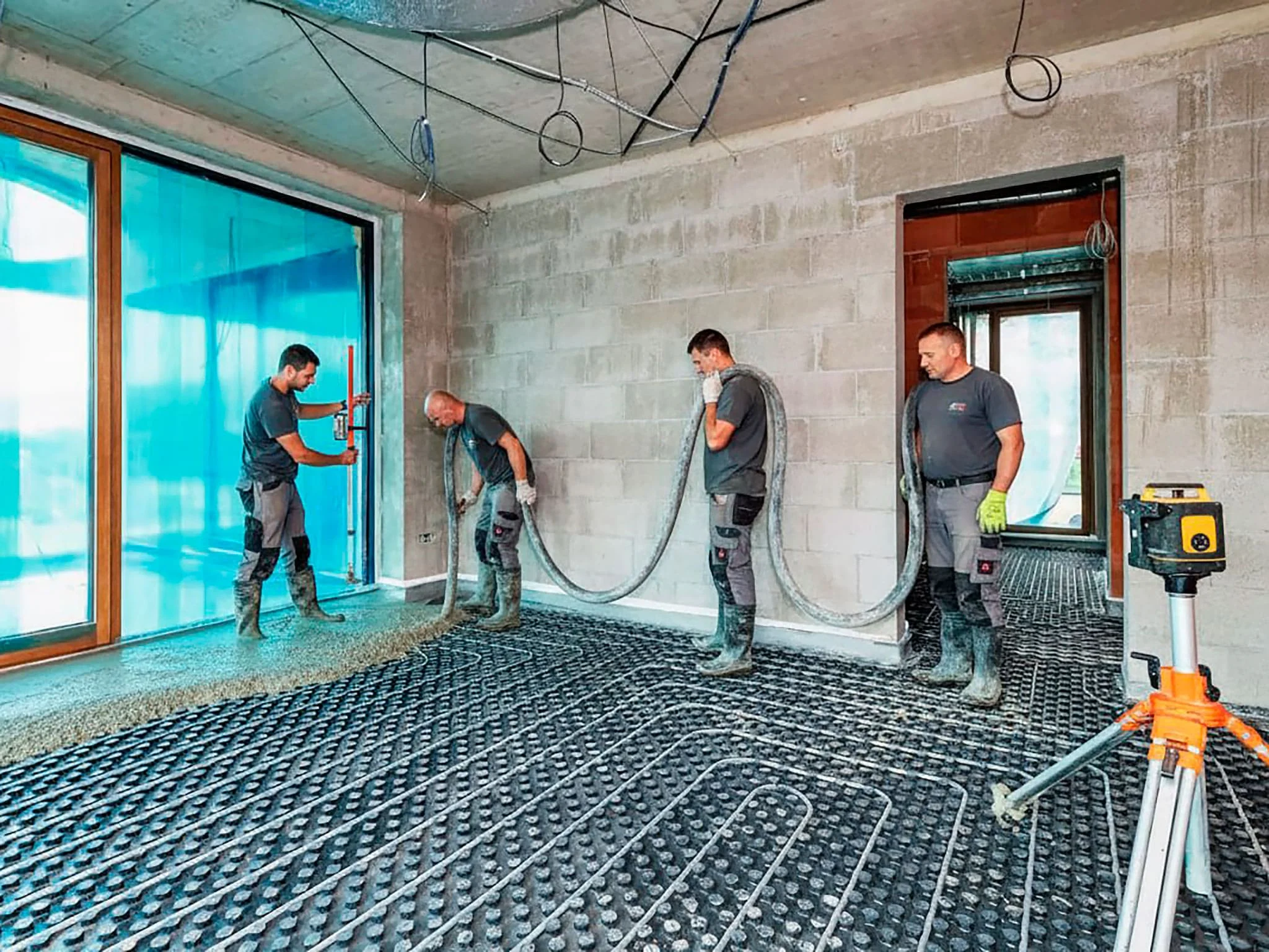
The whole process goes quickly. Laying anhydrite screed by a professional team often only takes a few hours. Installing anhydrite screed requires very little time, which speeds up the construction schedule.
How long does it take for anhydrite screed to dry?
Investors often ask: how fast does it dry? Anhydrite screed dries faster than cement screed in the initial phase (you can walk on it after 24–48 hours). Complete drying depends on the thickness and conditions, but the screed dries in several to a dozen or so days to the point where you can start heating.
Anhydrite screed price – how much does it cost per meter?
Is it worth the extra cost? The cost of anhydrite screed is usually higher than traditional screed. Anhydrite screed is more expensive, but it generates savings later.
What does the cost depend on?
The price of anhydrite screed depends on:
- Location;
- Layer thickness;
- Surface area (the more meters, the lower the unit price).
Average price per m²
What is the market price? The average price per m² of anhydrite screed (material with labor) ranges from 12 to 20 EUR, while the cost of cement screed is around 9 to 14 EUR. However, keep in mind that the cost of anhydrite screed is often offset by the fact that you don’t need to use self-leveling compounds under floor panels.
Advantages and disadvantages – summary of the features of anhydrite screed
Let's summarize the advantages and disadvantages of anhydrite screed to make your decision easier.
Advantages of anhydrite screed:
- Underfloor heating: Anhydrite screed heats rooms instantly (high conductivity coefficient);
- Self-leveling: Perfectly even floor;
- Speed: The screed dries faster than the cement screed in terms of accessibility (pedestrian traffic);
- Aesthetics: No expansion joints in thresholds on large surfaces.
Disadvantages and limitations:
- Moisture: Not suitable for outdoor use and requires excellent insulation in bathrooms;
- Grinding: The need to remove laitance (grinding the screed);
- Price: You will pay more per square meter than in the case of cement screed.
Anhydrite or cement screed – what to choose?
The decision: cement or anhydrite depends on your needs.
- If you have underfloor heating and you care about energy efficiency – anhydrite screed will be better;
- If you’re making a floor in a garage with a slope or if you have a very limited starting budget, then screed will be better in the cement version.
In many cases, due to its liquid consistency and thermal parameters, it is anhydrite screed that wins in modern homes.
Frequently asked questions (FAQ)
| What screed to choose for the garage? | Here, usually, cement screed is more suitable. Anhydrite can be damaged by water and salts from car wheels, unless you use very expensive resin insulation systems. |
| What is the thickness of the screed for the floor? | The recommended thickness of anhydrite screed is at least 35 mm above the pipes. In the case of cement screeds, you need to allow at least 45–50 mm, which increases the weight of the screed. |
| How much does a meter cost? | You will pay from 12 EUR per square meter and up, but the price of anhydrite screed depends heavily on the region and the size of the order (number of m²). |